Portendo AB
Portendo develops and markets threat
detection equipment for homeland security, military and commercial security
industries. Portendo's patent-pending technology can increase safety and
operational capability in high-risk environments by providing quick and reliable
detection of explosives, warfare agents and hazardous chemicals. The detection
is made at a safe distance from the threatening object ensuring increased safety
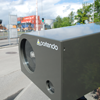
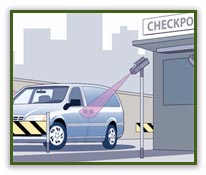
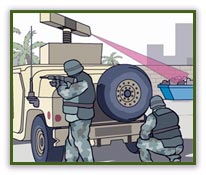
for the operators. Portendo has several development co-operations with high-ranking research institutes, including the Swedish Defence Research Agency, as well as customer co-operations within the defence industry. The company was founded in 2005 by Pierre Strömbeck, Peter Strömbeck, Daniel Svensson and Hans Mellström to commercialize Portendo's state-of-the-art explosives detection technology and system concept. Detecting Threats and Providing a Safer Environment Portendo's product portfolio is aimed at detecting explosives to provide a safer environment for troops, professionals and the general public. These products can be used in a variety of applications, with focus today on vehicle and cargo checkpoints. The common denominator is "saving lives" which we do efficiently while preserving the safety of the operator. Perimeter Protection To counter the threat of terrorist attacks on critical facilities and infrastructure in the civil society, there is a need for enhanced security including the ability to detect threats from vehicle-borne bombs. In a low-risk environment, preventive measures should be taken to avoid terror attacks on power plants, public transportation and certain events such as the Olympic Games. In a high-risk environment, security measueres are expanded to include road checkpoints, access control to hotels, shopping malls, etc. Portendo's products are well suited to be integrated in security checkpoints and they can perform detection of explosives residue on passing vehicles. The simple operation, low cost and speed of measurement of our products allow examination of a large number of vehicles and therefore provides a far better security level than technologies used today. Force Protection One of the most significant threats to military troops in hostile environments are IEDs (Improvised Explosives Device) and other CBE (chemical, biological and explosives) threats. It is today very difficult to detect and identify IEDs at a safe distance. For advancing troops, these hidden threats severly limits operating capability and safety, a problem that Portendo's P.Eye products addresses. The Products: P.Eye-S The Portendo P.Eye-S's represents the first product family for detecting explosives at safe distances (standoff detection). The P.Eye-S is suited for short-range remotely controlled detection in stationary and mobile vehicle checkpoints. Protecting Borders and Critical Facilities Portendo's P.Eye-S is perfectly suited to keep a facility or an area safe from terrorist threats without endangering your security personnel. Whether to keep VBIEDs away from power plants, sport stadiums or critical infrastructure or stopping suicide bombers at border checkpoints, the P.Eye-S will prove a necessary companion. State-of-the-art technology The P.Eye-S's unique features
provide detection and distinction of most explosive compounds that may be hidden
in cars, trucks, containers and baggage. P.Eye-S Advantages
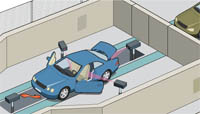
Portendo CheckPort Portendo's P.Eye-S is the core component in Portendo's CheckPort concept, a novel vehicle checkpoint concept for increased security in areas with elevated terror threat. The CheckPort consists of a complete package to enable state-of-the-art explosives detection technology to a vehicle checkpoint. It typically includes 1-3 P.Eye-S detectors, pan- & tilt-heads, power supply and an operator's workstation. The package also includes software and a training package for operators and security personnel. The P.Eye-S can also be used as a stand-alone detector together with a laptop as a user interface. Operation The P.Eye-S enables screening
of surfaces of vehicles and other objects for traces of explosives. Technology: Raman Portendo's detection methods are based on Raman scattering which provides a unique molecular signature enabling selective identification. The Raman scattering is triggered by energizing the substance with directed energy from laser beams. Different techniques are used to enhance the otherwise weak Raman signal. (C.V.Raman was awarded the 1930 Nobel Prize in Physics for his discovery). In Stand-off Detection unknown substances are detected and identified at a safe distance between the object and the detector/operator. To identify an unknown substance a laser beam is aimed at the object and the Raman scatter of the reflected light is detected and analyzed. The resulting signature is matched with a database enabling identification of the unknown substance. Portendo uses proprietary,
patent-applied enhancements to Raman spectroscopy to achieve performance improvements
of several orders of magnitude. Portendo participates in two governmentally funded research projects: LOTUS (Localization
of Threats in the Urban Society) is a research project sponsored by the European
Union seventh framework programme in the Security Research program. The LOTUS
concept is aimed at detecting precursors to explosives over a wide urban area.
Read more at the Lotus page at FOI. |